
Altair OptiStruct
Why OptiStruct?
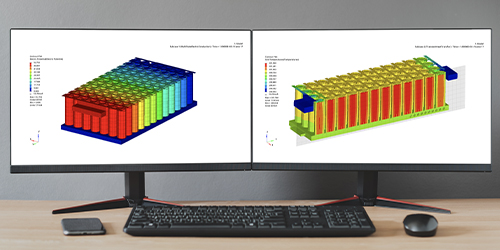
Multiphysics Simulations From One Model and One Solver
Engineers have traditionally relied on multiple CAE tools and simulation models to study various physical phenomena. With OptiStruct, engineers can assess multiple physics using one model. By integrating structural and multiphysics analysis, OptiStruct streamlines workflows and helps organizations accelerate time-to-market. The software seamlessly links implicit and explicit solvers, making it the ideal solution for multiphysics assessments like durability, heat transfer, acoustics, fatigue, and more.
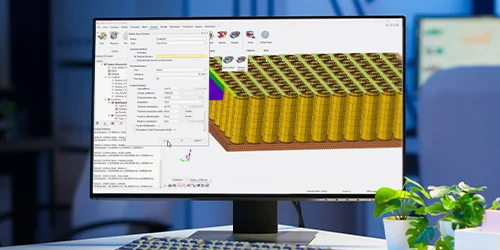
Open Architecture and Third-Party Support
Switching between software and translating models wastes time and disrupts workflows. OptiStruct enables engineers to work with their preferred tools while maintaining its One Model, One Solver methodology. Its open architecture lets engineers implement third-party code and customize the software to meet their specific needs. Prebuilt to interface with leading CAE technologies, OptiStruct makes it easy to extend features and streamline collaboration across platforms.
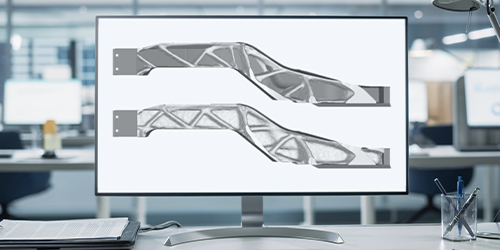
Leading Optimization
OptiStruct has set the standard for optimization across lightweighting, structural, multi-model, nonparametric shape, and multi-material topology applications. With these capabilities, engineers can enhance their designs for strength, weight, and manufacturability. The software can also optimize designs based on specific materials, like composites and lattices, or key performance indicators, like fatigue and sustainability. This advanced multi-attribute analysis and optimization functionality enables engineers to quickly iterate on models, balance design trade-offs, map the design space, and overcome development challenges.
Feature List
Structural Optimization
Use linear and nonlinear solvers to assess, optimize, and validate designs for stiffness, strength, dynamics, vibrations, acoustics, fatigue, heat transfer, fluid-structure interactions, electric potential, electrostatic forces, and more.
Material Analysis
Assess advanced materials properties for composites, lattices, and nonlinear materials (like viscoelastic, elastoplastic, and hyperelastic materials) through seamless integration with Altair® Material Data Center™, or study user-defined materials.
Vibration and Acoustic Analysis
Assess physics like vibration, frequency response, acoustics, and noise, vibration, and harshness (NVH). Use an automated multilevel sub-structuring eigen value solver (AMSES) or the fast frequency response (FASTFR) solver to assess dynamic behavior of the model.
Comprehensive Nonlinear Analysis
Comprehensive nonlinear features include modern, efficient contact algorithms, bolt and gasket modeling, elasto-plastic / hyperelastic / viscoelastic / viscoplastic material, and large deformation analysis.
Highly Nonlinear Explicit Analysis Capabilities
Assess highly nonlinear problems like drop tests, crash tests, impacts, bumps, erosion, damage, stretching materials beyond elastic yields, and more.
Real-World Multiphysics
Thermomechanical simulation and solver coupling for complex phenomenon including fluid-structure, electromagnetic-structure interactions, linking with manufacturing simulation and more.