
Altair Physics AI
Why PhysicsAI?

Accelerate Design Cycles
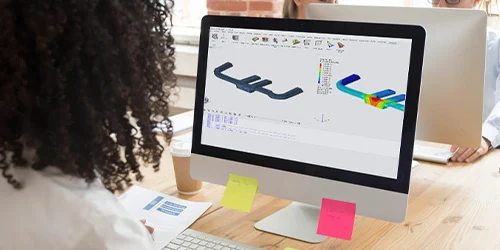
PhysicsAI operates directly on mesh or CAD models to produce fully animated physics outcomes at blazing speed across diverse physics applications. This streamlined approach takes a fraction of the time needed for traditional solver simulation and offers invaluable design performance insights. Whether you’re working with a crash model or HVAC design, PhysicsAI predictions slash runtime to seconds and what-if simulation studies from months to days.

Innovate Faster
PhysicsAI delivers fast physics predictions that enable engineering teams to test more design variations than possible with traditional solver simulation alone. More design exploration in less time helps companies discover ways to improve designs early in the development cycle so that they can bring innovations to market faster than the competition.
Predict with Confidence
AI-powered technology leverages your historical data to deliver the best possible physics predictions. At the training stage, powerful geometric deep learning trains PhysicsAI models with your specified simulation data, regardless of the data’s origin. To ensure reliable predictions, the physics AI environment provides workflows to assess predictions and validate them against traditional solver simulations.
Key Features
Native CAE File Support
The solver-agnostic PhysicsAI modeling environment lets you work directly with native CAE models, including historical simulation data models.
Geometric Deep Learning
PhysicsAI models are trained with groundbreaking geometric deep learning that operates directly on meshes and CAD models. This technology eliminates the time-consuming hand-crafting of parameters needed with other training methods.
Confidence Score Metric
PhysicsAI offers a confidence score that helps identify novel shapes in your data. By scoring geometric similarity, PhysicsAI prevents questionable predictions and ensures reliable results.
Altair HyperWorks-Guided Workflows
Simple workflows let you select trained models, generate predictions, and assess quality on a broad range of physics such as computational fluid dynamics (CFD), crash, and manufacturing.